
Entangled in the Canopy
A Review of Robert Moor’s In Trees: An Exploration

How much do we think about trees and forests? How much do we, collectively, act on their behalf? As of this writing, it’s been over two months since the US Forest Service was dismantled (or “restructured,” if you prefer the Orwellian term), which included the closure of fifty research facilities across thirty-one states. But the Trump administration’s “execution” of a storied federal institution barely made headlines in the mainstream press.1
Granted, we are asked to track a lot of federally overseen killing and destruction these days. It’s overwhelming and exhausting. But whatever our level of interest in trees—if such a thing can be gauged—the lack of furor over this latest offense suggests it’s not enough. Our collective disconnect has been laid bare like a clear-cut pine stand.
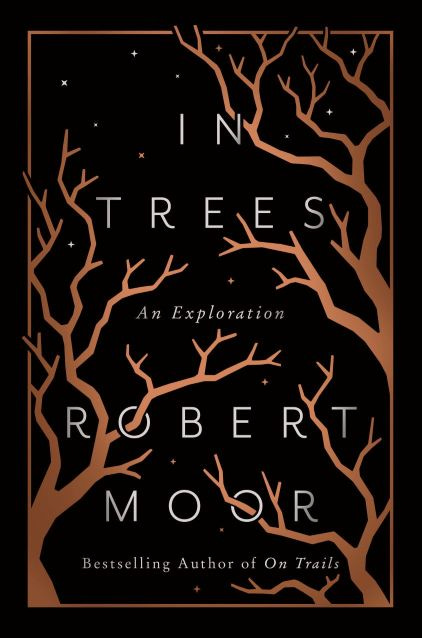
It wouldn’t be fair to bemoan all this without noting the exception—the professionals and ordinary citizens on the margins always engaging with, worrying about, and marveling at trees. Author Robert Moor is certainly in this group. To research his new book In Trees: An Exploration (Simon & Schuster), he dedicated a full decade climbing and communing with trees on several continents, along the way gathering wisdom from tree lovers and experts of all sorts.
In the genre of experiential journalism to which this book belongs, the writer’s adventures in far-flung locales sometimes serve as ends unto themselves: they dazzle the reader but do little else. Moor certainly entertains, particularly in the episode where, not very long after his first tree-climbing course, he ascends the crown of a giant sequoia while accompanying the film crew for David Attenborough’s Planet Earth. But as a “philosopher on foot,” to borrow a label the Wall Street Journal gave Moor in a review of his 2016 book On Trails, he seeks a higher mission. A true believer in trees, he wants them to lead the way, to be a force acting upon us and not vice versa. Rather than anthropomorphize trees, he wants to do the inverse—to “arborize humanity,” he writes in the book’s introduction.
The concepts Moor takes on, such as “arborescence” and “tree-thinking,” may seem opaque at first blush. But he makes things tangible by staking the book to the essential processes of trees—branching, pruning, gnarling, and rooting—processes that we’ve observed and ascribed meaning to as long as we’ve been a species. It’s not just that humans have an affinity with trees, Moor argues; we are entangled with them, a distinction he arrives at after considering different working definitions of a tree. “An ecologist named Tom Langen . . . was taught to define a tree as ‘a self-standing woody plant that a person can climb,’” Moor writes. “This definition—specifically, the emphasis on the tree’s entanglement with us—strikes me as truer than most.”
For Moor, the feeling of entanglement is most palpable up in the canopy, where he spends an exceptional amount of time over the course of the book. Entanglement reveals a primal sense of mutual dependency. “Trees are excellent teachers in this regard,” he writes. “To climb a tree is, necessarily, to care about its survival; your life and the tree’s life become knitted together.”
Many of us are daunted by scaling a tree, but we forget that as children, it’s a perfectly natural thing to do. And we’re the descendants of tree dwellers, an evolutionary thread Moor traces while observing chimpanzees in East Africa. During that expedition, he amusingly tries to live as a primate for one night by folding his body into the vacant tree nest of a chimpanzee. In another chapter we learn that some of the Korowai, a small tribe living in the Indonesian province of Papua, still maintain their tree-dwelling way of life. Sadly, though, it appears their treehouses are giving way to modernity’s advance.
Tree-sitting, as we see in the book’s final act, is more than an opportunity for awe and wonder. It’s also a widely used defense tactic against clear-cutting, as famously demonstrated in the 738-day-long tree sit by the activist Julia “Butterfly” Hill, who shares reflections with Moor about her protest nearly three decades ago. The author himself takes part in two different tree sits, one outside Vancouver and another, much larger one on Vancouver Island in Pacheedaht First Nation territory. Unsurprisingly, the clashes between the activists and the logging and gas pipeline interests are the book’s most charged moments. Although the tree defenders score concrete wins, they cannot entirely thwart the opposition. It’s ultimately a numbers game, and there aren’t enough comrades with the courage, patience, and free time to stick out an extended tree sit and all its attendant dangers.
Like many books that take on the climate crisis, a heavy feeling of loss runs through In Trees. Suffusing it all is the conviction that we in the modern age have denied our shared fate—our entanglement—with trees. (Indigenous peoples are the notable exception.) The environmental movement, Moor explains, was long driven by the “Green Revelation” and its “bright flash of secular nature reverence.” It remains a powerful force, but also a transient one and not widely shared. “That reverence,” Moor writes, “was an oddly uneven thing. It burned with blinding intensity in a small handful of people, but for some reason it remained all too dim in the rest of us. It was powerful enough to impel a man to light himself on fire to raise awareness about climate change, but it wasn’t enough to convince his compatriots to abide by even a modest carbon tax. It was a religion of shining martyrs and silent onlookers.”
Before Moor meets the Korowai, his conception of their communal tree-dwelling life sharply contrasts with the Green Revelation and its central trope: that of the solitary Westerner passing through a pristine forest, smitten by all its glory. “The Korowai . . . were able to maintain an extraordinary level of freedom, it seemed, precisely because they were tied inseparably both to one another and to the forest,” he writes. “Tree freedom, seen in this sylvan light, was nothing more, and nothing less, than a state of wild coflourishing.”
Today, that notion of wild coflourishing seems far out of reach. What can compel us to notice, let alone care about, trees? To raise hell about the dismantling of a forest service? It remains an open question. Moor, for his part, offers a spiritual vision with a clear first step: climb a tree and feel your entanglement with it.
Here I quote from the Substack More Than Just Parks, a great resource for keeping abreast on threats against US public lands.