
Remedies for Tree Blindness
A Reader’s Guide

A few years ago, after my wife and I planted a bur oak provided by our local tree commission, I suddenly was faced with all sorts of new questions. Among them: What is a bur oak? I would soon learn I suffered from what some call “tree (or plant) blindness.”
Not uncommon, tree blindness is a cultural affliction, not a medical one. Despite advocates’ best efforts, our contemporary Western culture doesn’t sufficiently value knowledge about trees or plants—or ecology generally. It’s hard to really see something when you don’t know what you’re looking at.
For most of human history, though, being tree blind wasn’t viable. The Indigenous peoples of North America and across the world have known this all along; they never stopped learning from and caring for their ecosystem. For many of us, the climate crisis has been the slap in the face we need to see that trees, along with pollinators and soil and all the rest, are essential to a functioning planet.
For answers to my tree-related questions, I’ve turned to the obvious sources: local experts, podcasts, apps (shout-out to the indispensable iNaturalist), and books. In my experience—and this probably won’t come as a shock—books have been the most rewarding path to knowledge. Reading about trees isn’t just important business, though; it’s also a great source of pleasure.
I created this guide for anyone who is a little (or very) tree blind and wants reading suggestions. As with any worthy topic, I’ve found there are all sorts of tree books and reasons for picking them up—to fill a gap in knowledge, read a compelling story, even engage in deep questions about the cosmos.
These are my recommendations for the most common types of books a beginner would be interested in. I’ve also included a handful of alternate picks.
The Primer for the Newbie
Colin Tudge, The Tree (Three Rivers Press)
An effective primer requires the right author, one who knows everything about their subject but recognizes his readers don’t. Biologist and author Colin Tudge has a knack for lucid explanation, breaking complex things down to their essential parts. With the title of the book’s first part—“What Is a Tree?”—he starts with the very basic: “A tree is a big plant with a stick up the middle.”
That cheeky definition gets deconstructed, and from there, the book’s scope gets much, much broader. The main section, “All the Trees in the World,” is an extended taxonomic review, which Tudge contextualizes within the taxonomy of all creation (Darwin’s Tree of Life, if you will). His lists break trees down by order, family, genus, species. Interspersed throughout are plenty of interesting anecdotes and tidbits about trees.
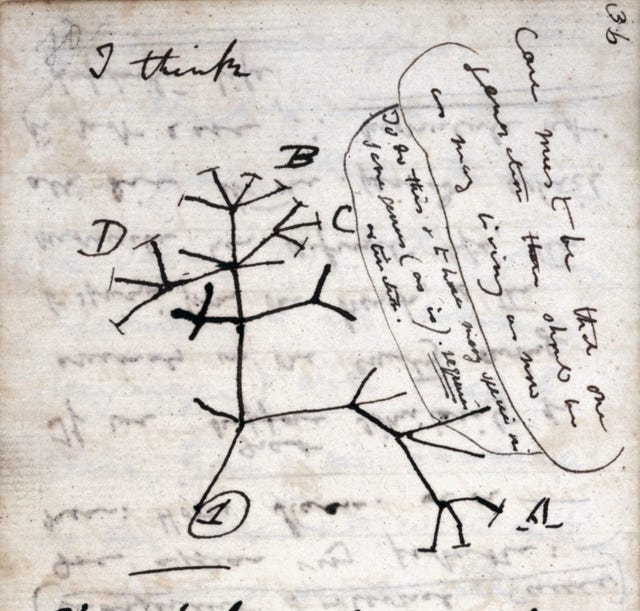
The takeaway is that learning about trees is humbling. We are told in the opening pages that there are around 60,000 different tree species, which means that both the newbie and the erudite dendrologist are more or less in the same boat, continually floored by the earth’s diversity. As Tudge observes, when it comes to trees and all other natural phenomena, “we have very little idea indeed of what’s out there.”
Alternate: The Tree Book: The Stories, Science, and History of Trees (DK/Smithsonian)
This coffee table book is for the visual learners. Like Tudge’s primer, The Tree Book also covers a broad span and includes an overview of various tree species, but in a totally different format. While the writing doesn’t compete with Tudge’s eloquence, The Tree Book makes up for it with striking visuals, including detailed illustrations and photographs of the essential components of a tree and its functions.
The Deep Dive
Susan Freinkel, American Chestnut: The Life, Death, and Rebirth of a Perfect Tree (UC Press)
On the other end of the spectrum from the book on “all the trees” is the deep dive into one genus or species. Some trees have enough drama in their history to warrant the full narrative treatment. That is certainly the case with the American chestnut.
For those who haven’t already heard the sad story, the American chestnut was once the deciduous tree, the “Redwood of the East” and producer of an essential tree crop, especially in the Appalachian region. Its tasty, vitamin-rich fruit wasn’t merely a treat for occasionally “roasting on an open fire,” and the bounty provided for many non-humans as well. But then a blight, a pathogenic fungus called Cryphonectria parasitica, came along in the early twentieth century and spread town to town, state to state. Initial efforts to save it were noble but not informed by the best science. Until recently, it seemed the tree (with a few rare exceptions) would never again grow past a certain age and height before the blight knocked it back down.

The final act of American Chestnut is cathartic—mostly. A silver-bullet solution for restoring the species hasn’t been found, but through a mix of old and new strategies (backcrossing and bioengineering, respectively), the species’ eventual return is now conceivable. Susan Freinkel believes that the chestnut’s modest resurgence has only been possible through the stubborn will of not just professional experts but humble volunteers. “Everyone who works on chestnut is passionate,” a veteran chestnut researcher tells her. “You have to be; the odds aren’t in your favor.”
Alternate: Doug Tallamy, The Nature of Oaks: The Rich Ecology of Our Most Essential Trees (Timber Press)
An oak, you may remember, was what set off this whole endeavor of mine. Doug Tallamy’s book takes a charming month-by-month tour through a year in the life of an oak, with a full cast of supporting characters including blue jays, squirrels, gall wasps, and skippers, to name just a few. Tallamy, a professor of entomology and wildlife ecology, makes the persuasive case that oaks reign as a keystone native species, delivering highly valuable “ecosystem service.” (Tallamy also founded Homegrown National Park, a terrific grassroots organization helping gardeners fully commit to growing native plants.)
The Long View
Jared Farmer, Elderflora: A Modern History of Ancient Trees (Basic Books)
Sitting under an old tree can spur reflective thinking, and if the trunk you’re resting against is very old, your thoughts may roam all the way back to that tree’s germination, or range ahead to the majestic specimen you imagine sprouting from a nearby acorn. This is the perspective of “timefulness” that Jared Farmer employs in Elderflora, though the book’s scope is even grander than that, surveying humankind’s relationship to the world’s longest-lived trees.

The book is as much elegy as philosophical treatise: Farmer explains that a byproduct of modernity is the decline in our collective capacity to venerate the “Old Ones”—to use his term of affection—let alone care for them or protect them from the axe. The world’s tree canopy is paying the price. Even though, as the author concedes, the number of total trees has expanded, we haven’t compensated for the loss of elderflora. “A dwindling percentage of tree cover consists of species-rich old-growth communities,” he writes. The loss is recorded in both lower biodiversity and lower “chronodiversity,” which he defines as “a condition of temporal richness in a particular habitat or ecosystem.”
“Chronodiversity” is one of several keywords that help articulate Farmer’s heady concepts. (His “Lexicon for Slow Plants on a Burning Planet: A Companion to Elderflora” is available online.) The book’s creative terminology is useful and necessary: in this age, what once came natural to us—venerating the living and mourning the fallen—requires a new lexicon.
Alternate: John Perlin, A Forest Journey: The Role of Wood in the Development of Civilization (Patagonia)
In nearly every corner of the globe, societies have developed and declined through their access to wood. Demonstrating a staggering level of research, John Perlin’s A Forest Journey charts the boom and bust over millennia. It’s a endless, frustrating cycle: a new wood-dependent technology is discovered; all the nearby supply is harvested; more wood is sought elsewhere. Originally published in 1986, the book’s updated and expanded 2023 edition covers forest conservation in a time of climate crisis. Like Elderflora, this edition also has a useful online companion, available at the Patagonia website.
The Paradigm Shift
Suzanne Simard, Finding the Mother Tree: Discovering the Wisdom of the Forest (Alfred A. Knopf)
Competition is the organizing principle of the world, whether you’re an average Joe or Jane scrapping for a job or a tree scrapping for water and sunlight.
Or is it? Suzanne Simard, who grew up in British Columbia and started her career in the Canadian forest service before moving into forest ecology, had a hunch that trees collaborate as much as they compete. Most of her colleagues in the male-dominated field of forestry didn’t want to entertain any theory (especially from a woman) challenging the prevailing wisdom about trees—namely, that letting them grow without competition from other species (known as the “free to grow” policy) is the proper way to produce the highest volume of wood. Finding the Mother Tree chronicles her decades-long quest to change stubborn minds on this practice.
Simard’s investigative point of entry was not the trees themselves but what lay in the soil under them: an underground mycorrhizal network of fungi binding trees together. This network, she would eventually prove, facilitates the exchange of carbon, water, and nutrients; it even allows trees to send each other warning signals about pests and pathogens. Vital connections also exist between trees of different species as well as between “mother trees” and younger saplings, with a single mother tree able to support hundreds of younger trees.
Simard’s research ultimately reveals the ways a forest thrives through collaboration and complexity. The hope is that her findings reach beyond the converted, persuading decision-makers to ditch the “free to grow” approach once and for all. Instead of heading down the road to hell, the one paved by clear-cutting and monoculture, we can chart a different course that allows forests and mother trees to thrive.
The Grand Narrative
Richard Powers, The Overstory (W.W. Norton)
This is the only work of fiction on the list, and as winner of the 2019 Pulitzer Prize, it’s probably the most recognized and prestigious of the “tree books.” I encourage anyone put off by a non-nonfiction recommendation not to be. Richard Powers, a novelist steeped in the science of his books, here seamlessly weaves the countless wonders of trees through his epic narrative.
I call it “epic” because it covers a vast stretch of time and nine different main characters. The upshot of such a large scope is that the plot touches on topics covered in all the books above (which is why I’m discussing this one last). For instance, the long family line of Nicholas Hoel features an old American chestnut that survives the blight. The dendrologist Patricia Westerford discovers that trees can communicate with one another, though many of her peers fail to believe her. (In interviews, Powers has acknowledged Suzanne Simard as inspiration for the character.) All the main figures in The Overstory are equally enthralled by the Old Ones—and equally crushed by the knowledge that humans are failing to protect them.
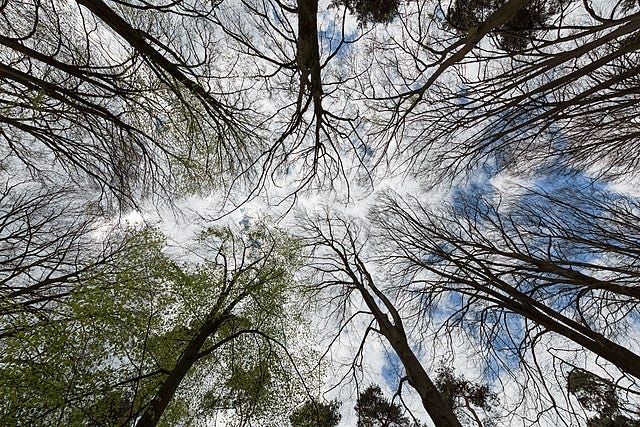

For this group of nine, who in the opening pages are scattered throughout the country, what starts as a childhood awakening about a forest or a familial attachment to a special tree turns into arboreal obsession. Many of them become radicalized and willing to lay down their lives for trees. Perhaps inevitably, they end up in a showdown with logging interests in the California redwood forest.
I have to briefly mention my favorite scene in The Overstory, an extended tree-sitting protest to save a giant redwood named Mimas. Way up in their perch and with plenty of time on their hands, two of the protagonists pass the hours by—of course—reading a book about trees: The Secret Forest by Patricia Westerford. Had it been a real book, not one by a fictional character, I would certainly have added it to my reading list.
I hope this guide is helpful. Writing about books on trees is an ongoing project, so there’s a good chance I will come back and revise or expand this list.
I’m eager to hear what I may have missed. What would you include in a reader’s guide for the tree blind?