
Evolution's Dance
A Review of Andrew L. Hipp’s Oak Origins: From Acorns to Species and the Tree of Life

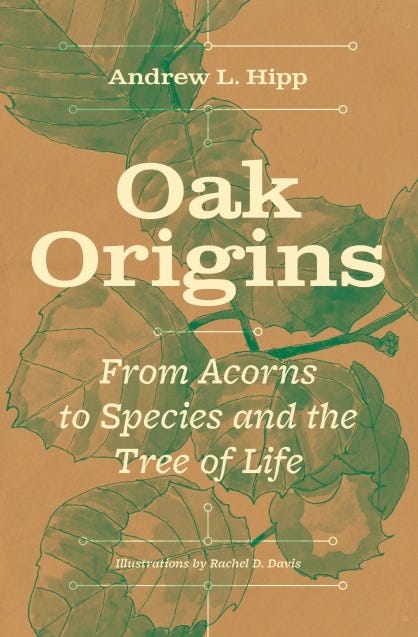
One of the biggest surprises in Oak Origins comes more than halfway through the book, in the account of how Miles Davis’s Bitches Brew came together. Through Hipp’s own listening journey with the album’s first track, “Pharaoh’s Dance,” we learn it was the pioneering tape-splicing technique of producer Ted Macero that helped push Bitches Brew into the jazz stratosphere.
For the majority of jazz works preceding and following Davis’s 1970 album, the standard track is the “studio take”—the musical recording as performed by bandleader and musicians. Not so with Bitches Brew. With the exception of “Miles Runs the Voodoo Down,” the tracks aren’t takes; they’re assemblages of various extended jams recorded from August 19 to 21, 1969.1 When you stop and consider all the raw material at Macero’s disposal, the album really could have been many different things, or aborted altogether. Through studio wizardry, the producer forged it into the sonic mosaic we know today.
At first, Hipp’s detour is curious—and I’m sure my calling attention to it here is equally so. What does this have to with oak trees? A good deal, it turns out. Hipp, herbarium director and senior scientist in plant systematics at the Morton Arboretum, explains that an oak tree also is a mosaic, and also a product of voluminous (genetic) material. Behind the reproduction of each oak is a Macero-esque process, an evolutionary pathway forging all that material into a distinct specimen. (For me, a dendrophile eager to dive into the science of oaks but sometimes hard-pressed to digest the literature, a handy analogy like this is gold.)
So, encoded in the ninety-minute Bitches Brew are many hours of musical improvisation; encoded in the oak genome are eons of evolutionary improvisation. The lineage of oaks, like the lineage of all plant genera, is the product of long geological time. A key evolutionary agent for oaks is adaptive introgression, “gene flow that moves beneficial alleles from one species to another,” Hipp writes. (The rate of gene flow is unusually high in Quercus thanks to easy hybridization among species, for which “oaks have earned—perhaps justly—a reputation for promiscuity.”)
This resilient lineage is shaped by other geological and ecological wonders, such as species migration (affected by continental drift and periods of global warming and cooling), windborne pollination (the section on how oak pollen spreads far and wide is an entertaining read), and biotic seed dispersal (the best disperser of acorns is the blue jay with its capacious throat pouch).
The lineage and the forces shaping it comprise what Hipp calls the “oak tree of life,” which “represents a single bough on the larger Tree of Life.” It’s only one bough, but a significant one. A detailed Quercus taxonomy, including subgenera and, within them, eight total sections, illustrates an astounding diversity and adaptability in oaks, through which they have formed a near-continuous band around the Northern Hemisphere. Hipp explains that the reach of Quercus in the Southern Hemisphere is slight, but, in the long future, this may not always be the case. Q. humboldtii, the “lonely oak” found only in Colombia and Panama, “may one day become the progenitor of a whole clade of South American oaks.” Such is the fluid nature of adaptation.
The frame of view widens in the chapter “Origins: Fagaceae,” which traces back to the age before Quercus’s arrival on the scene, when the beech family was still working out its pedigree. The view is, paradoxically, just as expansive in the places where Hipp drills down, observing the microverse of entities like pollen grains, leaves, and acorns. (A similarly granular portrait appears in Doug Tallamy’s terrific The Nature of Oaks, a yearlong travail through the life of an oak and its associates.) Hipp details the pivotal role this small microverse plays for both oaks and the biosphere. “The communities of insects, fungi, and other organisms that depend on oaks make every oak tree—every leaf and acorn, in fact—an ecosystem.”
Wrapping one’s head around oaks—and their genetic origins, in particular—is a challenging task, despite Hipp’s commitment to making the material accessible. For those of us without a degree in biology or related subject, this isn’t easy reading. Fortunately, the central question driving the book’s investigation, shared in the opening pages, is a simple one: What is an oak? After walking with our guide through the past and present of Quercus, the question’s answer deepens and expands.
Hipp also discusses the Bitches Brew-oaks connection in a 2019 article published in PeerJ, in which he points out that “Pharaoh’s Dance” was written not by Miles Davis but Joe Zawinul, also featured on the album. See Hipp AL. 2019. Pharaoh’s Dance: the oak genomic mosaic. PeerJ Preprints 7:e27405v2, https://doi.org/10.7287/peerj.preprints.27405v2.